

深圳市环球众一科技有限公司
专业从事电磁兼容测试、电气安全测试、
无线射频和电信终端类产品测试、化学测试认证和代理

深圳市环球众一科技有限公司
专业从事电磁兼容测试、电气安全测试、
无线射频和电信终端类产品测试、化学测试认证和代理
Button Cell GPSR Certificate, Detailed Explanation of UK Battery Regulation PAS 7055:2021
The UK 'Button / Coin Cell Battery Safety Standard' (PAS 7055:2021) is a national standard issued by the British Standards Institution (BSI) on April 30, 2021, and came into effect upon publication. The following is a detailed interpretation of this regulation:
01 Regulatory Background<<<<
Based on two incidents in which children died from ingesting button batteries, the UK healthcare safety investigation department wrote related reports, recommending the establishment of a standard to specify consistent safety requirements for such batteries throughout their entire lifecycle, which led to the introduction of this regulation.
PAS 7055:2021 Scope<<<<
This standard applies to non-lithium button cells and lithium coin batteries with a diameter not exceeding 32mm, as well as products using such batteries, such as flashlights, greeting cards with audio, novelty balloons, electronic scales, remote controls, keychains, garage door openers, and watches.
PAS 7055:2021 Scope of Inapplicability <<<<
Disposal and recycling from an environmental protection perspective.
Aspects already covered by existing standards, such as safety requirements for battery manufacturing, as well as products already covered by specific standards, including toys, audiovisual equipment, and medical devices (such as thermometers and hearing aids).
PAS 7055:2021 Regulatory Requirements<<<<
The voluntary PAS 7055:2021 (UK Button Battery Safety Public Specification) was published in April 2021. This specification includes the following guidelines:
Labeling, instructions, and packaging (including warnings);
Consistency of safety and health warnings;
Merchandising, such as display and placement;
Encouraging and promoting safe disposal and/or recycling;
Product safety of typical consumer products using button cells and coin cells, including requirements for warning text and safe battery compartments.
The following cases are not subject to PAS 7055 regulations:
Disposal and recycling from an environmental protection perspective;
Professional and industrial batteries;
Aspects already covered by existing standards, such as safety requirements for battery manufacturing, requirements for toys or audiovisual equipment; medical devices, such as thermometers and hearing aids.
I. Child-Resistant Packaging Requirements for Batteries<<<<
Packaging for lithium coin batteries (regardless of size) and button batteries with a diameter ≥16mm should comply with:
1) AS 5808-2009;
2) BS EN IEC 60086-4:2019;
3) BS EN ISO 8317:2015;
4) BS EN 862; and
5) USA: 16 CFR §1700.15.
The requirements for child-resistant packaging are covered by multiple safety standards, and compliance with any one of them is sufficient.
2. Warning Label Requirements <<<<
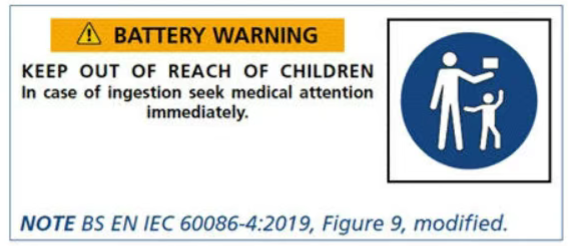
Coins or lithium battery packaging should be labeled and marked according to the requirements of Figure 1, including text, warnings, and contrasting colors.
Note: if color labeling is not possible, black and white may be used.
This is an internationally recognized symbol used to convey the message 'keep out of reach of children.' That is, these products should be placed where children cannot reach them to prevent accidental ingestion.
2. Button Battery Warning Labels
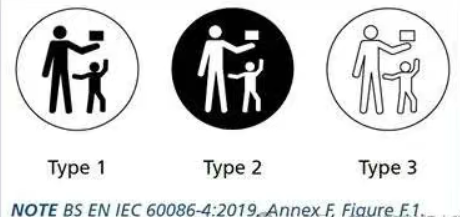
The markings on the packaging of button batteries or non-lithium batteries should include the warning, text, and contrasting colors as shown in Figure 2.
Note: If using color for the symbol is not possible, black and white may be used (see Figure 3).
The battery packaging should include the following warnings or equivalent warnings:
• "Battery warning: Keep out of reach of children"; and
• "Seek medical attention immediately if swallowed or inserted into any part of the body."
The warnings on the packaging should be permanent, clear, and indelible. The battery must not be deformed during disassembly (e.g., when using multiple installed batteries).
3. Warning labels on the battery
Batteries with a diameter of not less than 20mm should have sufficiently large diameter markings to be clearly visible. Battery packaging should include warning labels, such as 'Keep out of reach of children' and 'Seek medical help immediately if the battery is swallowed or placed inside the body.'
4. Safety markings on products containing batteries
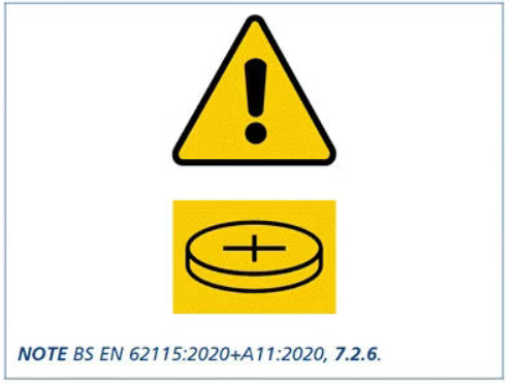
Products containing batteries (regardless of chemical composition) should include the warning symbol shown in Figure 4 on the product. Wherever possible, the marking should be displayed on or near the battery compartment.
The warning on the product should be permanent, clear, and indelible.
Note: If it is not possible to add the warning to the product, or if doing so would make it difficult to read, the warning should be added to the packaging
5. Warning Labels on Packaging of Consumer Products Containing Batteries
Packaging of consumer products containing batteries should include the following or equivalent warnings:
1. "BATTERY WARNING: KEEP OUT OF REACH OF CHILDREN."
2. "If the battery compartment (if applicable) does not close securely, stop using the product and keep it away from children."
3. "If you think batteries might have been swallowed or placed inside any part of the body, seek immediate medical attention."
Battery Warning Standards
When using the warning signs shown in Figures 1, 2, 3, and 4, the following requirements should be met:
a. The safety sign should have a strong contrast with the background and occupy at least 50% of the pictogram area;
b. The diameter of the safety sign should be 6mm or larger;
c. The warning text 'BATTERY WARNING: KEEP OUT OF REACH OF CHILDREN' should contrast with the printed background color.
3. Other Requirements<<<<
1. Fixed Battery Compartment:
The design of the battery compartment door/cover for any consumer product containing one or more batteries should reduce the possibility of being unintentionally removed by vulnerable persons.
This can be achieved by one of the following methods:
• Requiring the use of tools such as a screwdriver or coin to open the battery compartment;
• The battery compartment door/cover must require at least two independent movements to open. For example, one action must be held in place while the other action is performed.
Battery compartment doors/covers should comply with:
• BS EN 62115:2020 A11:2020, 13.4.1;
• BS EN IEC 62368-1:2020 A11:2020, 4.8.3 and 4.8.5.
2. Battery compartment fasteners:
If screws or similar fasteners are used to secure doors/covers providing access to the battery compartment, the screws or similar fasteners should be secured to the door, cover, or equipment. Under normal use conditions or reasonably foreseeable conditions of use, screws or similar fasteners must not become loose from the door, cover, or equipment.
Battery compartment fasteners should comply with:
• BS EN IEC 62115:2020 A11:2020, 13.4.6;
• BS EN 60598-1:2015 A1:2018, 8.2.6.
3. Non-replaceable batteries:
Batteries that cannot be removed or replaced and can be accessed without the use of tools (for example, batteries that may be found in greeting cards or clothing items) should comply with UL4200A:2015, Section 6.4.
4. Spare or bulk batteries:
All spare or bulk batteries provided with consumer products (if the battery is not pre-installed in a secure battery compartment) should comply with the aforementioned requirements for battery manufacturers:
• Button cell requirements (see PAS 7055:2021, 4.2.2);
• Child-resistant packaging requirements (see PAS 7055:2021, 4.1);
• Coin cell requirements (see PAS 7055:2021, 4.2.1);
• Markings on batteries (see PAS 7055:2021, 4.2.4);
• Markings on packaging (see PAS 7055:2021, 4.2.3).


